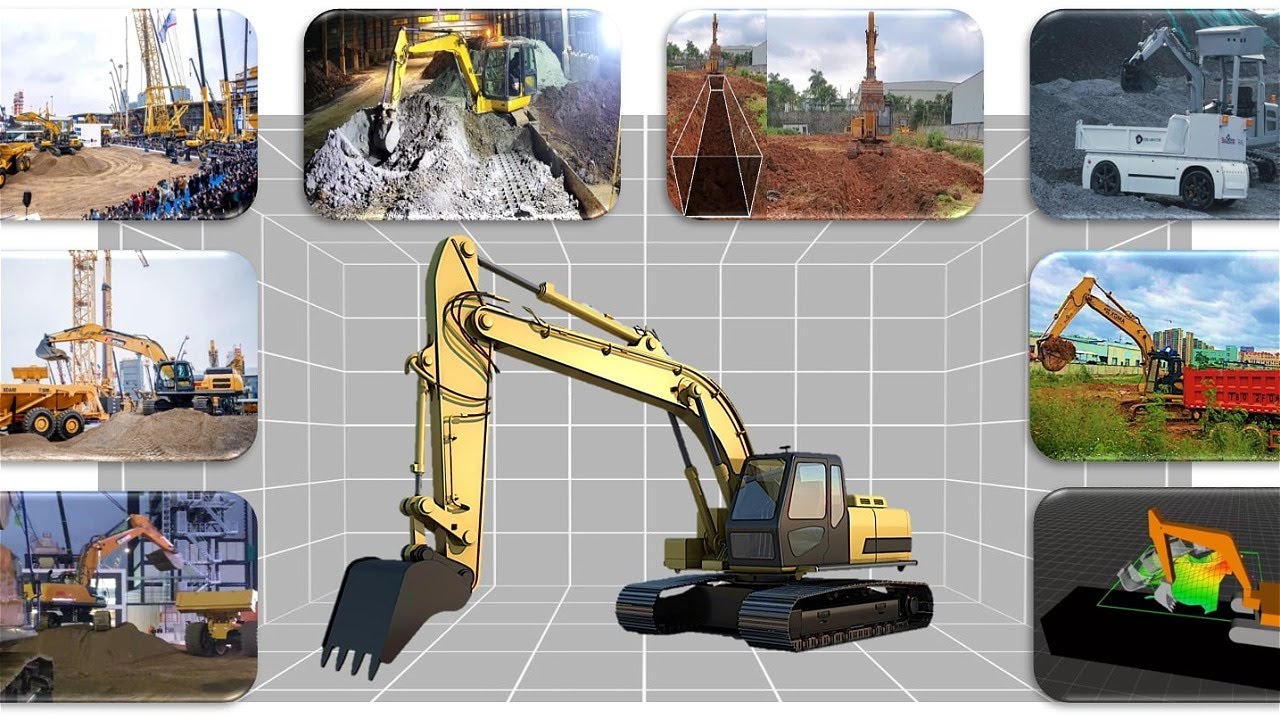
Autonomous Machinery System
Applying robotics, AI, and edge computing to make traditional heavy machinery more intelligent, safer, and more productive.
RoboForce Engineering Interview discussion
Jason Ye, Project Core Contributor, previous work at Baidu USA, 2020-2024
From lab research to real industrial autonomy deployment.
About me
- Zhixian Ye, or Jason
- UCSD ECE robotics track
- Baidu Research RAL, Sensing World AI/product, GM perception
Why it mattered
- Labor shortage in harsh industrial sites
- Improve safety without replacing people
- Jiangsu waste-factory excavator ran 24/7
Engineering goal
- Parse high-level customer tasks into common autonomy commands
- Share perception, planning, control, and safety modules
- Reuse simulation and replay across machine types
A hierarchical stack turned operator intent into coordinated base and arm execution.
Human-Robot Interface
Operator dispatches high-level work: move, dig, trench, supervise.
Task Resolver
Parses commands into segments, work cycles, and executable robot behaviors.
Base Loop
- Encoders, cameras, LiDAR, RTK localization
- Global route, local mapping, path following
- Obstacle avoidance while repositioning the machine
Arm & Digging Loop
- Inclination sensors and hydraulic valve readings
- Camera/LiDAR material-height and pile-shape sensing
- Dig, move, dig cycle with calibrated MPC/PID-style controls
The platform generalized from one machine to multiple industrial robots.
Machine boundary
- Reused excavator perception on wheel loader and crane
- Normalized sensors, image sizes, mapping, and localization
Autonomy stack
- Shared perception and edge-computing pipeline
- Common ROS-style middleware and A-to-B planning
Operations & safety
- Shared fleet dispatcher UI and business metrics
- Safety zones, stop-sign detection, state machines, fallback
Sim/replay loop
- Vendor simulator for base motion, arm motion, and materials
- Unit, replay, and CI tests before field deployment
The project created research visibility, IP, commercial traction, and a reusable autonomy platform.
Top robotics and automation venues across control, planning, perception, and autonomy.
Motion execution, machine interfaces, perception deployment, and safety workflows.
Local China deployments plus overseas commercial opportunities, including Brazil.
Reusable autonomy foundation scaled across excavator, wheel loader, crane, and others.
My contribution
- Core contributor: motion planning, execution cycles, HRI/frontend, perception streaming, frame buffers, AI deployment
- Supervised a research intern and led a 5-person SmartCrane project team
- Balanced customer requirements, ops deployment/testing, and resource-limited delivery
Personally authored 5+ papers; 3 patents filed, 2 granted.
Imitation Learning and Model Integrated Excavator Trajectory Planning
Excavator autonomy depends on trajectories that are productive, safe, and repeatable under changing terrain.
Operational pressure
- Increasing labor cost and skilled-operator shortage
- Hazardous environments and repetitive cycles
Technology timing
- Better sensors, compute, and AI made closed-loop autonomy practical
- The planner sits between perception and hydraulic execution
Planning challenge
- Pure rules are stable but brittle
- Pure learning adapts but needs feasibility guarantees
Each planning family wins on a different axis, which made a hybrid method attractive.
| Criterion | Rule | Optimization | Imitation learning | Reinforcement learning |
|---|---|---|---|---|
| Optimality | * | **** | *** | ***** |
| Generalization | * | **** | *** | ***** |
| Stability | ***** | **** | *** | **** |
| Training / data efficiency | **** | ** | **** | ** |
| Application efficiency | ***** | ** | **** | ** |


STOMP iteratively samples trajectory perturbations and moves toward lower-cost feasible motion.
Why STOMP
- Gradient-free method
- Flexible with mixed objectives
- Can refine non-smooth trajectory costs
Main risk
- Sensitive to initial trajectory
- Requires parameter tuning
- Pure linear initialization can be weak
Hybrid fix
- Use the IL actor trajectory as the initial reference
- Let optimization handle constraints, volume, and smoothness
Guidance from the IL actor
Resample the trajectory generated by the actor and use it as the optimizer's reference.
The optimizer balances feasibility, human-like guidance, smoothness, and excavation volume.
Point + trajectory cost
Each sampled trajectory is scored point-by-point, then aggregated across the whole bucket path.
Hard constraints
Keep trajectory points inside the predefined 3D excavation area and away from invalid states.
Human-like guidance
Use the IL actor trajectory as a reference so optimization starts from an operator-like motion.
Smoothness + volume
Prefer smooth bucket motion while targeting the desired amount of material per excavation.
The evaluation compared the hybrid method against pure learning and pure optimization baselines.
Tested algorithms
- IL+STOMP: proposed hybrid algorithm
- Pure-IL: actor trajectory revised for kinematic feasibility
- Pure-STOMP: linearly initialized optimizer without guidance cost
Protocol
- 3 episodes for each method
- 15 excavations per episode
- Same initial terrain state per episode; POA selected by rules


IL+STOMP improved excavation weight while retaining high success and lower variance.
| Epi | Index | pure-STOMP | pure-IL | IL + STOMP | ||
|---|---|---|---|---|---|---|
| value | vs STOMP | vs IL | ||||
| 1 | Avg-W | 0.763 | 0.905 | 0.969 | 26.96% | 7.15% |
| Stdev | 0.176 | 0.193 | 0.148 | -15.59% | -23.09% | |
| Suc-R | 0.867 | 1.000 | 1.000 | 15.38% | 0.00% | |
| 2 | Avg-W | 0.742 | 0.978 | 0.964 | 29.94% | -1.35% |
| Stdev | 0.146 | 0.185 | 0.143 | -1.75% | -22.62% | |
| Suc-R | 0.867 | 1.000 | 1.000 | 15.38% | 0.00% | |
| 3 | Avg-W | 0.813 | 0.920 | 0.960 | 18.00% | 4.30% |
| Stdev | 0.101 | 0.236 | 0.108 | 6.95% | -54.30% | |
| Suc-R | 0.800 | 1.000 | 1.000 | 25.00% | 0.00% | |
| Total | Avg-W | 0.773 | 0.932 | 0.965 | 24.77% | 3.25% |
| Stdev | 0.144 | 0.204 | 0.131 | -8.78% | -35.52% | |
| Suc-R | 0.844 | 1.000 | 1.000 | 18.42% | 0.00% | |
Trajectory shapes under the same terrain state.

Generic and specialized IL models reduced weight variance, while rocky terrain required more conservative behavior.
| Model | Baseline | Wooden block | Generic | ||
|---|---|---|---|---|---|
| value | improvement | value | improvement | ||
| Avg-W | 0.21248 | 0.22882 | 7.69% | 0.22754 | 7.09% |
| Min-W | 0.02530 | 0.12740 | 403.56% | 0.08190 | 223.72% |
| Max-W | 0.39370 | 0.32060 | -18.57% | 0.32160 | -18.31% |
| Stdev | 0.08332 | 0.05127 | -38.47% | 0.05391 | -35.30% |
| Suc-R | 0.5556 | 0.8444 | 52.00% | 0.7442 | 33.95% |
Interpretation
- Material type changes the relationship between trajectory shape and moved volume
- Specialized learning can reduce variance when material behavior is consistent
- Rocky terrain such as wooden block pushes the planner toward conservative choices
The method improved excavation weight up to 24.77% while keeping low variance and high success rate.
What worked
Learning supplied a strong initial trajectory prior; optimization made it constraint-aware and physically safer.
What remains hard
A larger and more diverse dataset is needed for broader terrain, material, and machine variation.
Where it goes next
More advanced learning methods and real excavator experiments close the loop from benchtop to field deployment.